
 Base
Base Unichain
 Robinhood
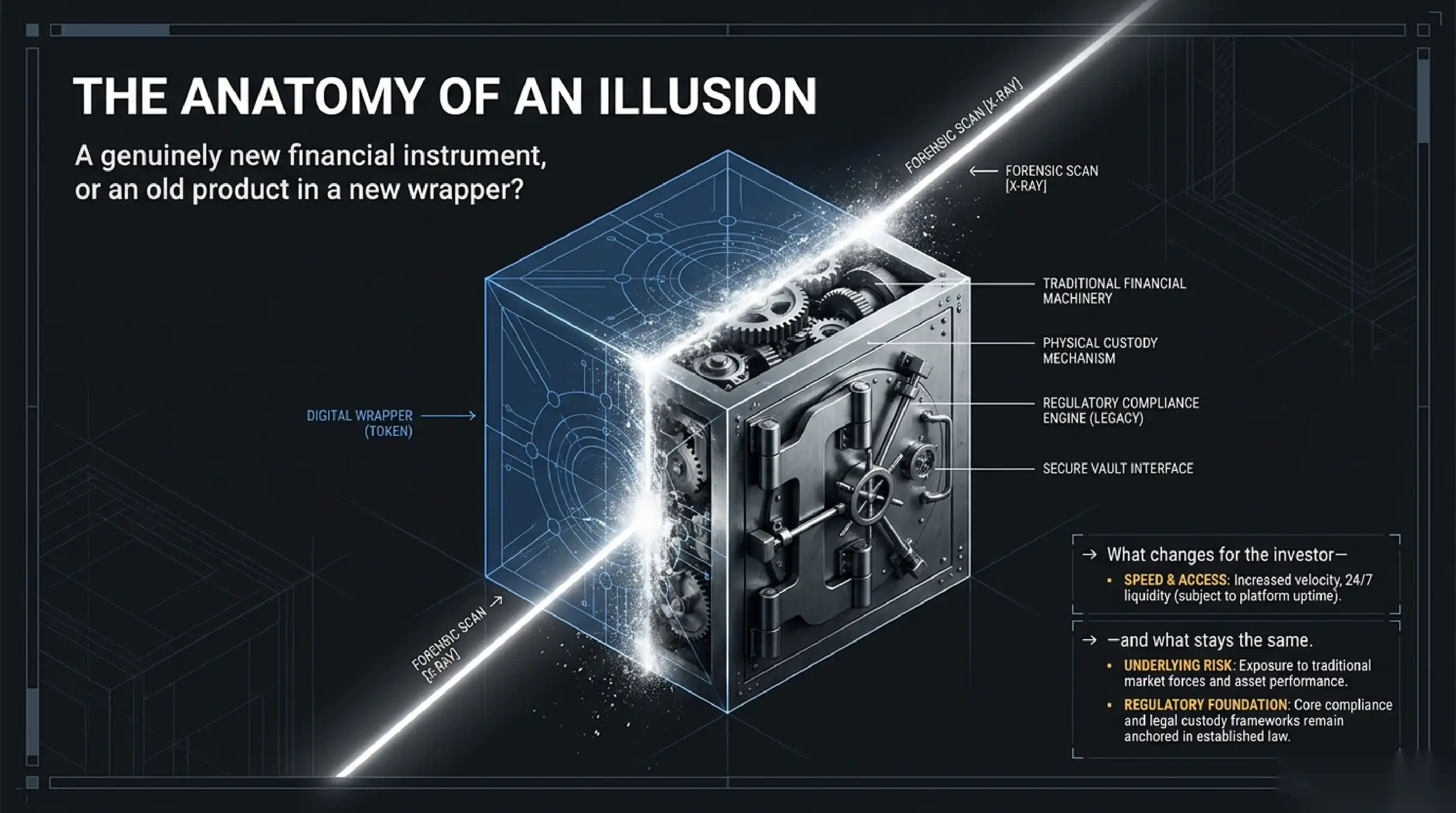
A tokenized fund promises to turn a share in an investment fund into a token on a blockchain, but behind the attractive idea sits a simple question: what actually changes for the investor and what stays the same. The answer matters more than any marketing, because it separates a genuinely new instrument from an old product in a new wrapper.
What is actually tokenized
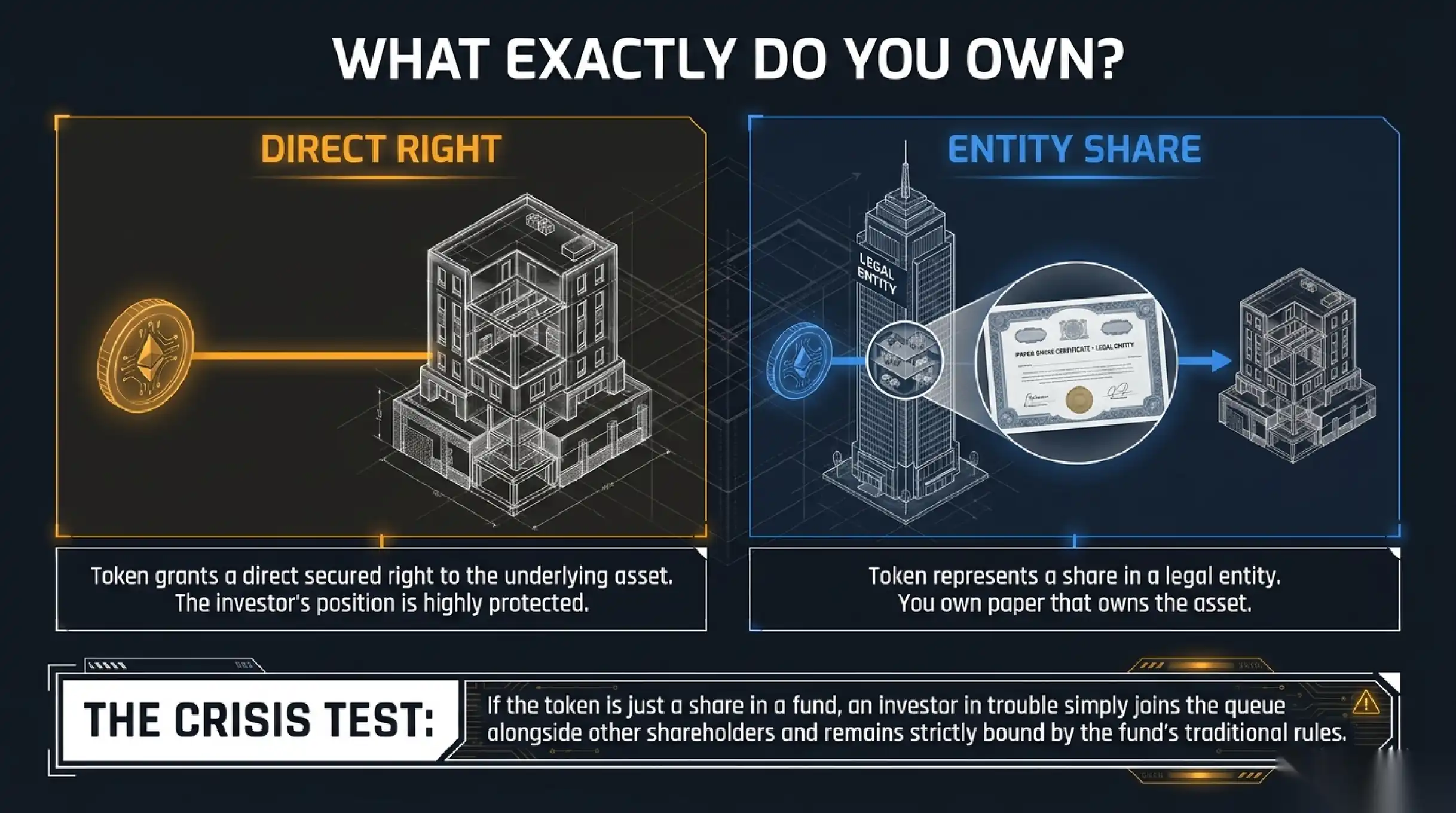
The first question sounds mundane: is the asset itself tokenized or only a share in the fund that owns the asset. These are not the same. In most cases the token represents a share in a legal entity, not a direct right to the underlying asset. So the investor depends on how that entity is structured, who manages it and what rights the share grants.
The difference shows up in a crisis. If the token is a share in the fund, then in trouble the investor joins the queue alongside other shareholders and is bound by the fund’s rules. If the token grants a direct secured right to the asset, the investor’s position is stronger. So the first thing to establish is the legal nature of what the token actually records.
The second layer is which assets sit in the fund. Tokenizing liquid securities and tokenizing illiquid real estate or private debt are very different products with the same word on the cover. The less liquid the underlying asset, the more questions arise about valuation and about the real ability to exit.
Settlement and speed: the promise and the caveats
The main promise of tokenization is instant settlement and round the clock operation. In theory transferring a fund share stops taking several days and happens in seconds on any day of the week. For the investor this means less time with money frozen in the settlement process and more flexibility in managing a position.
In practice the promise carries caveats. The token moves instantly, but subscription and redemption through the fund itself still follow its schedule, valuation and rules for accepting orders. What becomes fast is secondary trading of the token between investors, not operations with the fund itself. This distinction matters, because the secondary price can detach from the share value, and instant transfer turns from an advantage into a source of risk.
So the investor must understand where their trade actually happens. Buying a token from another holder is one thing, and subscribing for new shares directly in the fund is another, and the speed of these two paths can differ by a wide margin.
The custodian and who holds the real assets
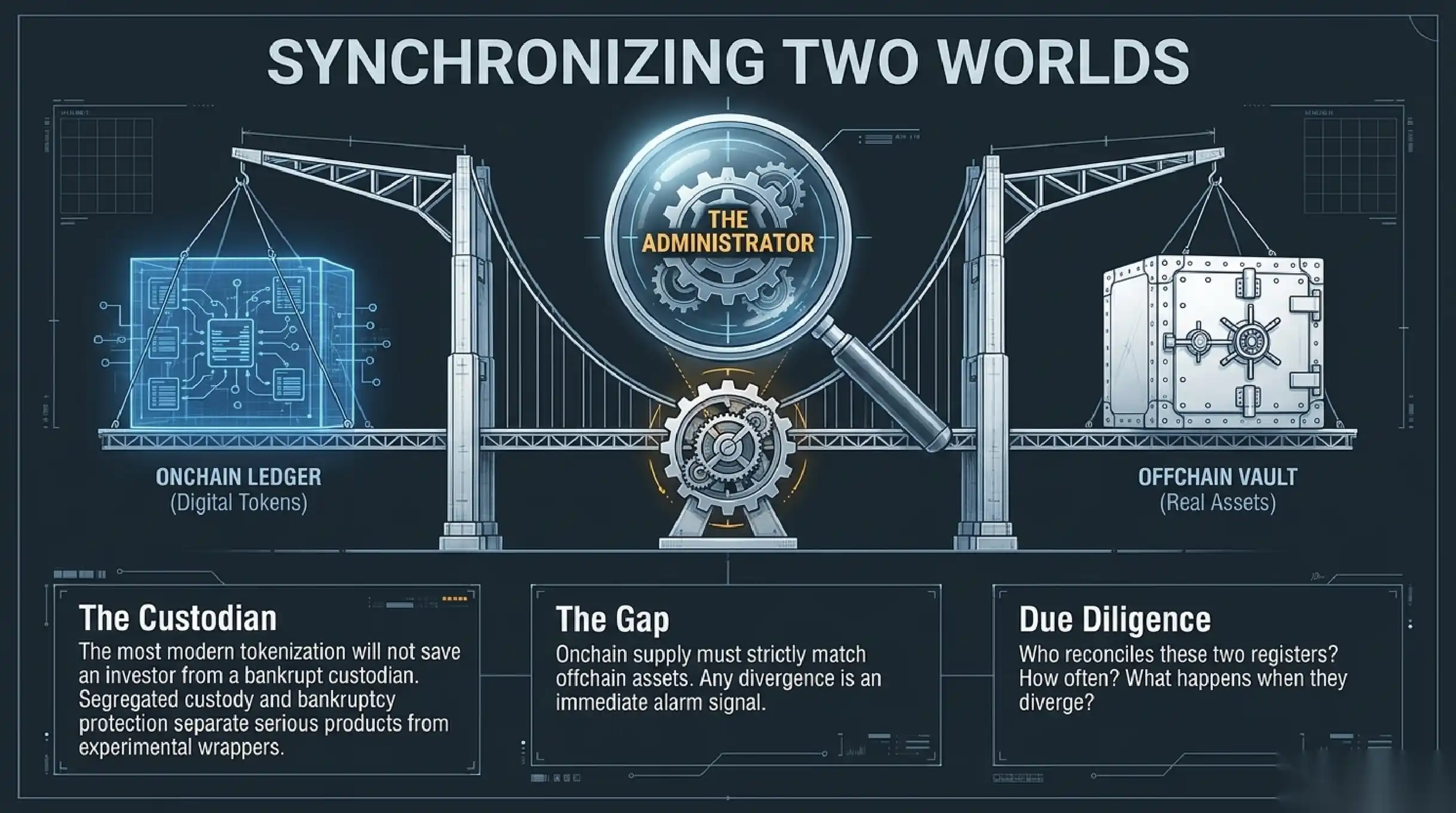
Behind every tokenized fund sits a custodian that holds the real assets and an administrator that keeps the records. The quality of these participants matters more than the blockchain on which the token is issued. If the custodian is unreliable or does not separate client assets from its own, the most modern tokenization will not save the investor in its bankruptcy.
A separate question is synchronization between the onchain supply and the offchain assets. The number of tokens must strictly match the number of fund shares, and any gap is an alarm signal. A sensible investor checks who reconciles these two registers and how often, and what happens when they diverge.
It also matters where the assets sit legally and whose they are considered in the manager’s bankruptcy. A structure with segregated custody and bankruptcy protection gives the investor far more than a promise in a slide deck, and its presence is what separates a serious product from an experimental wrapper.
Secondary market liquidity versus fund liquidity
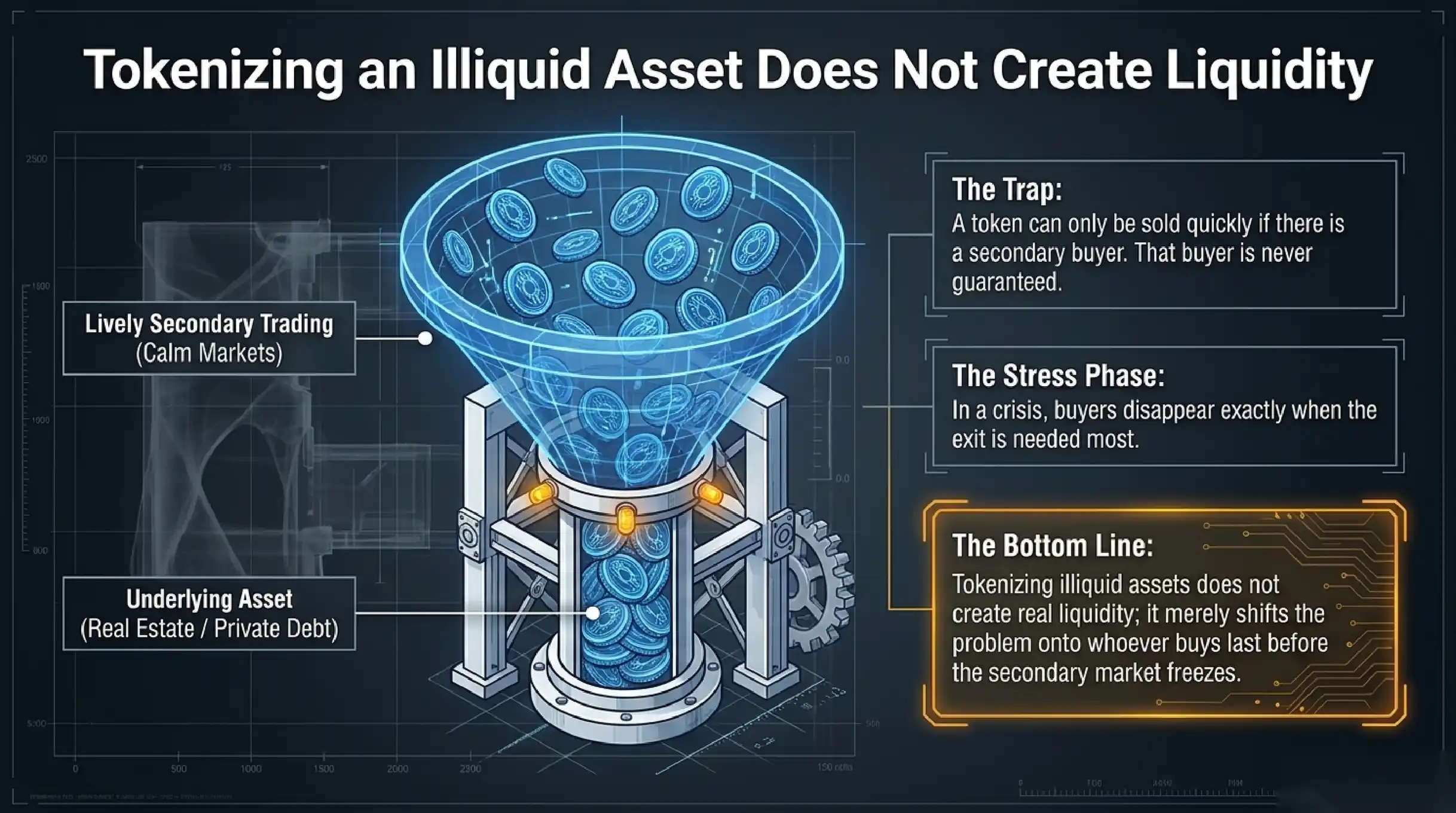
Tokenization is often sold as a way to make an illiquid fund liquid. This is a tempting but dangerous idea. A token can be sold quickly only if there is a buyer on the secondary market, and that buyer is not guaranteed. Token liquidity and underlying asset liquidity are different things, and confusing them is expensive.
In calm times the secondary market can look lively, but in a stress phase buyers disappear exactly when the exit is needed most. If the underlying asset remains illiquid, the token does not create real liquidity; it merely shifts the problem onto whoever buys last. So the depth of the secondary market should be judged not by average turnover but by behavior on the worst days.
Investor rights and the legal wrapper
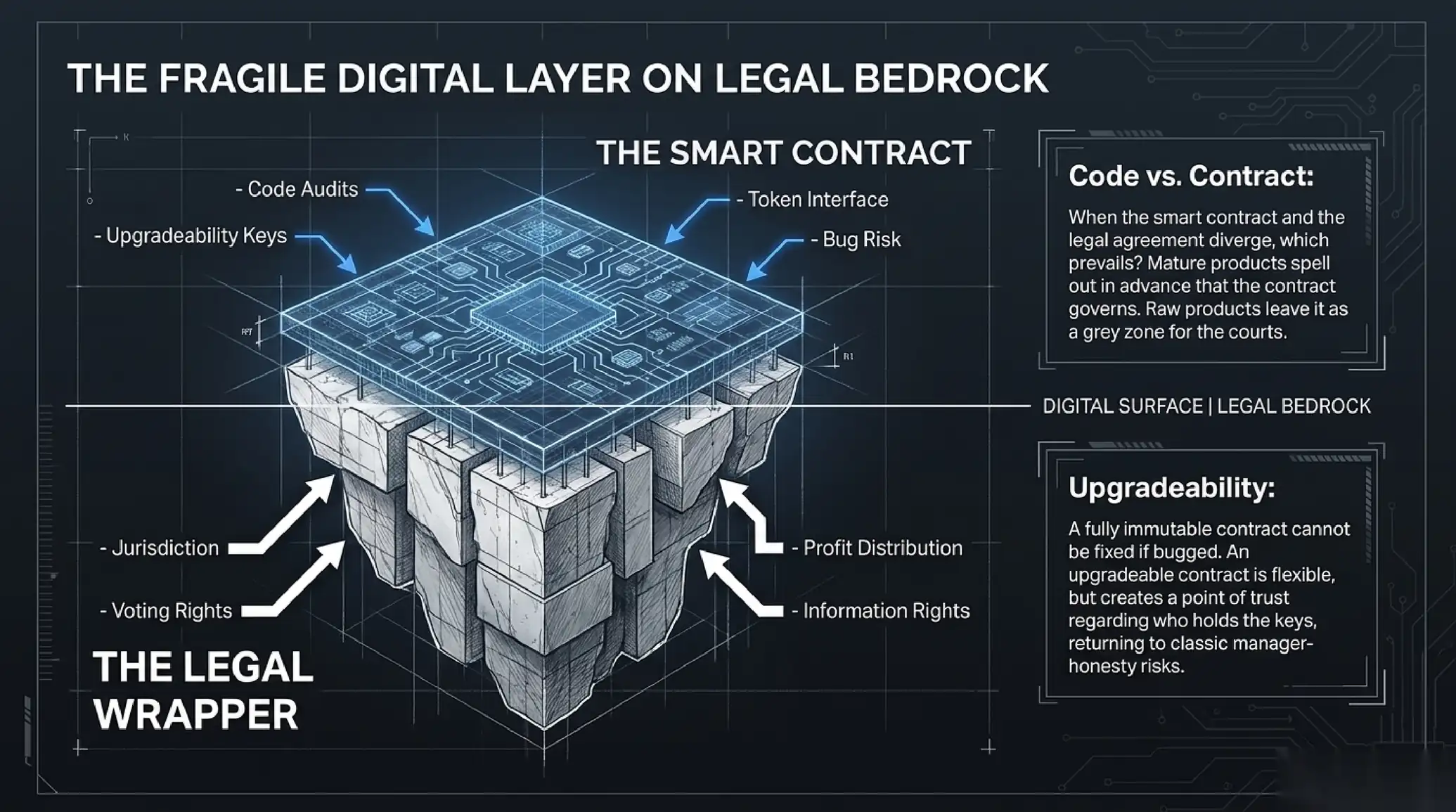
A token is a technical record, but the investor’s rights are defined by the legal document behind it. It matters whether the share grants a vote, a right to profit distribution and a right to information, and in which jurisdiction these rights are protected. A polished app interface does not replace answers to these questions.
Special attention belongs to what happens in a conflict between the code and the contract. If the smart contract and the legal agreement diverge, which one prevails. Mature products spell out the answer in advance, while raw ones leave it a grey zone that surfaces only in court and always at the wrong time.
Fees that hide in the structure
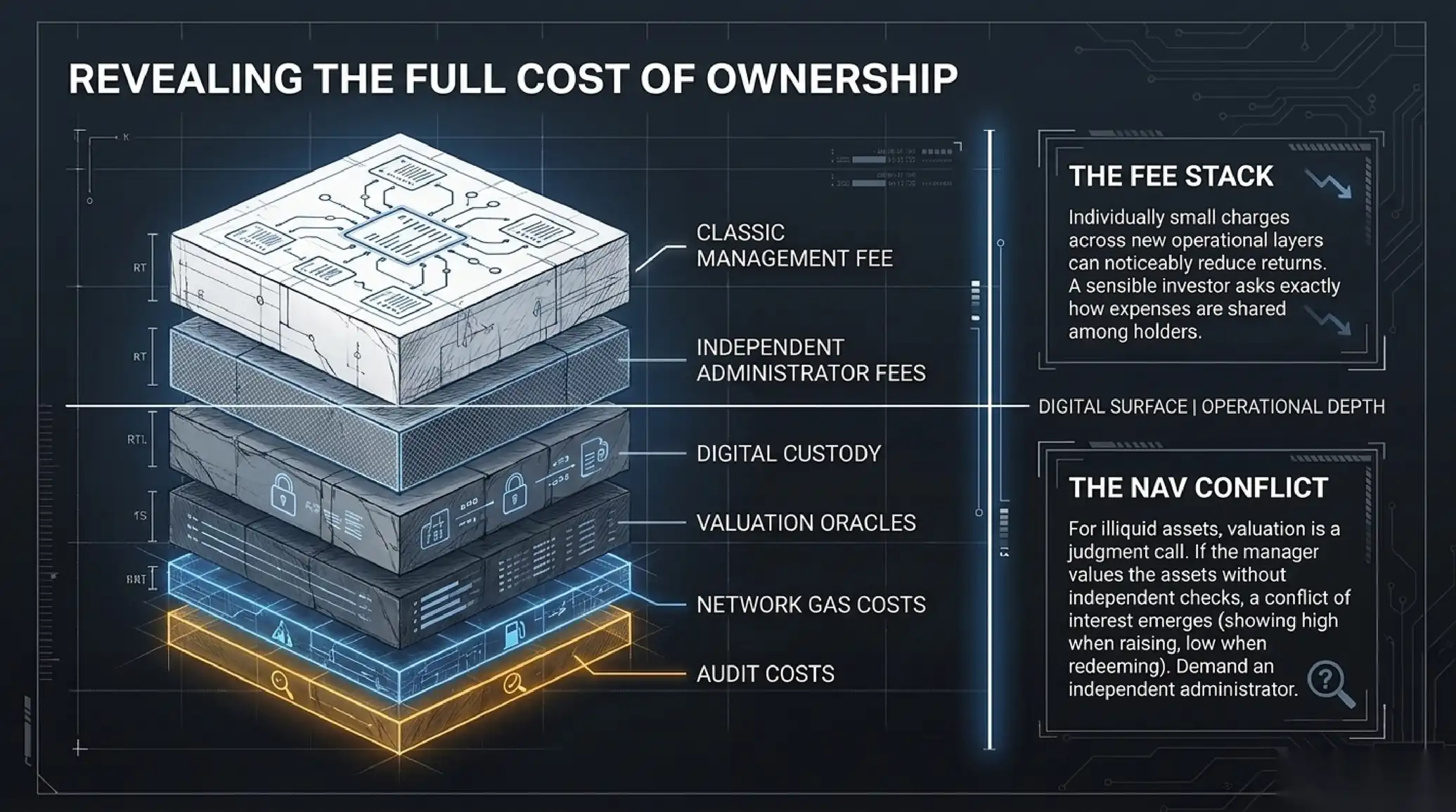
A tokenized fund adds new layers, and every layer can take a fee. On top of the classic management fee come the costs of issuing the token, of a digital asset custodian, of valuation oracles and sometimes of the network itself. Individually these charges are small, but together they can noticeably reduce returns.
A sensible investor counts the full cost of ownership, not only the stated management fee. It helps to ask who pays for gas on transfers, who bears the audit costs and how these expenses are shared among holders. A product that cannot answer these questions clearly is most likely hiding costs in the fine print.
Valuation and who computes NAV
The key question in any fund is the price of a share, and in a tokenized wrapper it does not disappear but grows more complex. Someone has to compute the net asset value, and the fairness of the price at which an investor enters and exits depends on who does it and how often. If the manager values the assets without independent checks, a conflict of interest appears: there is a temptation to show a higher price when raising money and a lower one when redeeming.
For liquid assets valuation is simple because a market price exists. For illiquid ones it becomes a judgment, and this is where most manipulation hides. The token can trade on the secondary market at a price that differs noticeably from the computed share value, and the investor must understand which of the two figures matters for their trade. The sensible approach is to demand an independent administrator and a clear valuation methodology rather than trusting a single line in an app.
Taxes and reporting do not disappear
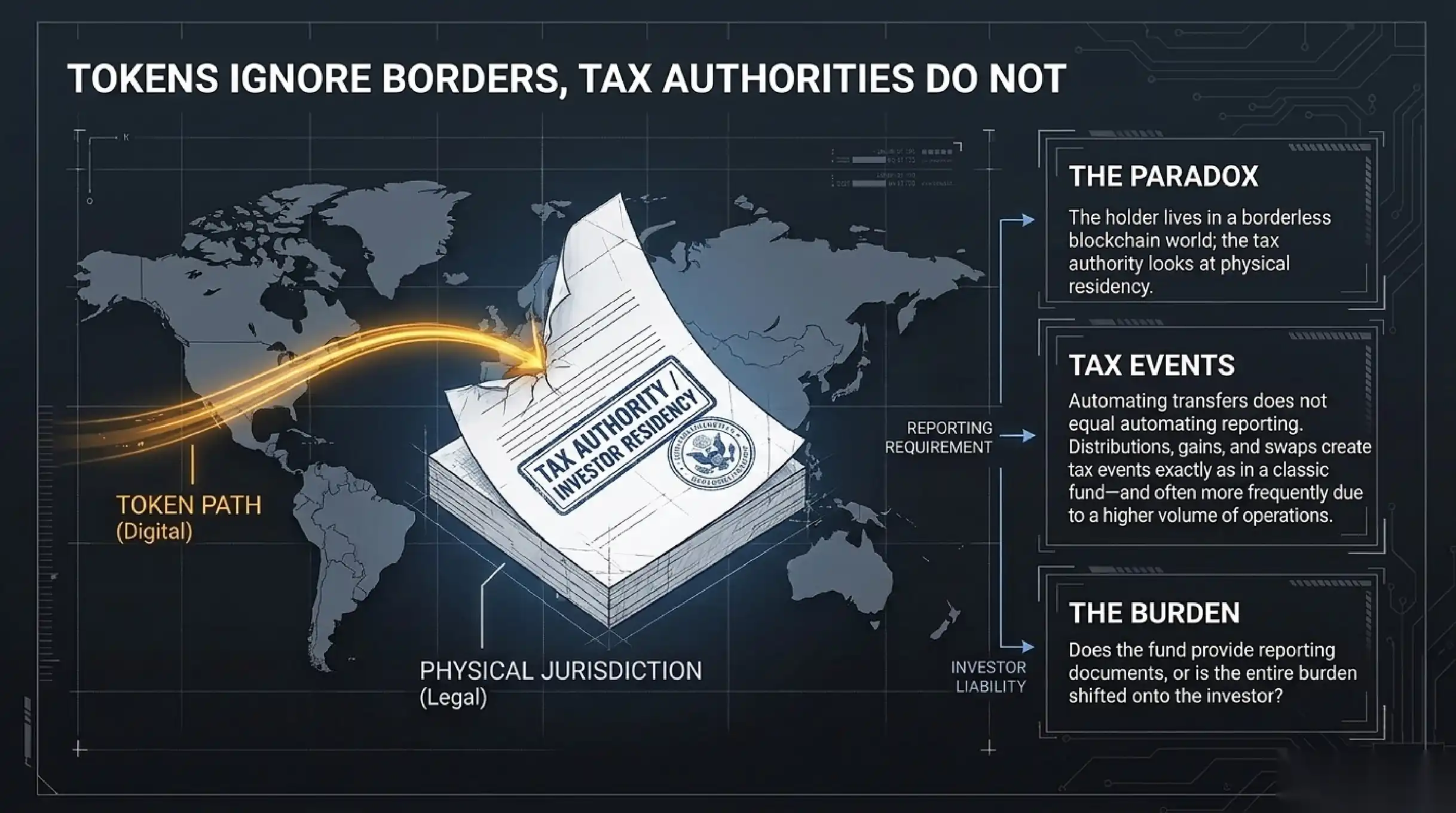
Tokenization changes the technical form of ownership but does not cancel tax obligations. For the investor this means that distributions, gains and swaps can create tax events exactly as in a classic fund, and sometimes more often because of the larger number of operations. Automating transfers does not equal automating reporting.
A separate difficulty is that a token easily crosses borders while tax rules are tied to the investor jurisdiction. A holder may think they live in a borderless blockchain world, but the tax authority looks at their residency. So before buying it helps to understand what documents the fund provides for reporting and whether that entire burden has been shifted onto the investor.
Smart contract risk and upgradeability
A token lives in a smart contract, and the quality of that code becomes part of the product risk. A bug in the contract can freeze transfers, distort share accounting or open a path to theft. A code audit reduces this risk but does not remove it entirely, and the investor should understand whether the contract passed an independent review and who is responsible for fixing any problems found.
A separate question is upgradeability. If the contract can be changed, it matters who holds the upgrade keys and what limits are placed on them. A fully immutable contract protects against arbitrary action but does not allow a bug to be fixed. An upgradeable contract is more flexible but creates a point of trust that returns the investor to the same questions about the manager honesty as in a classic fund.
Who the counterparty really is
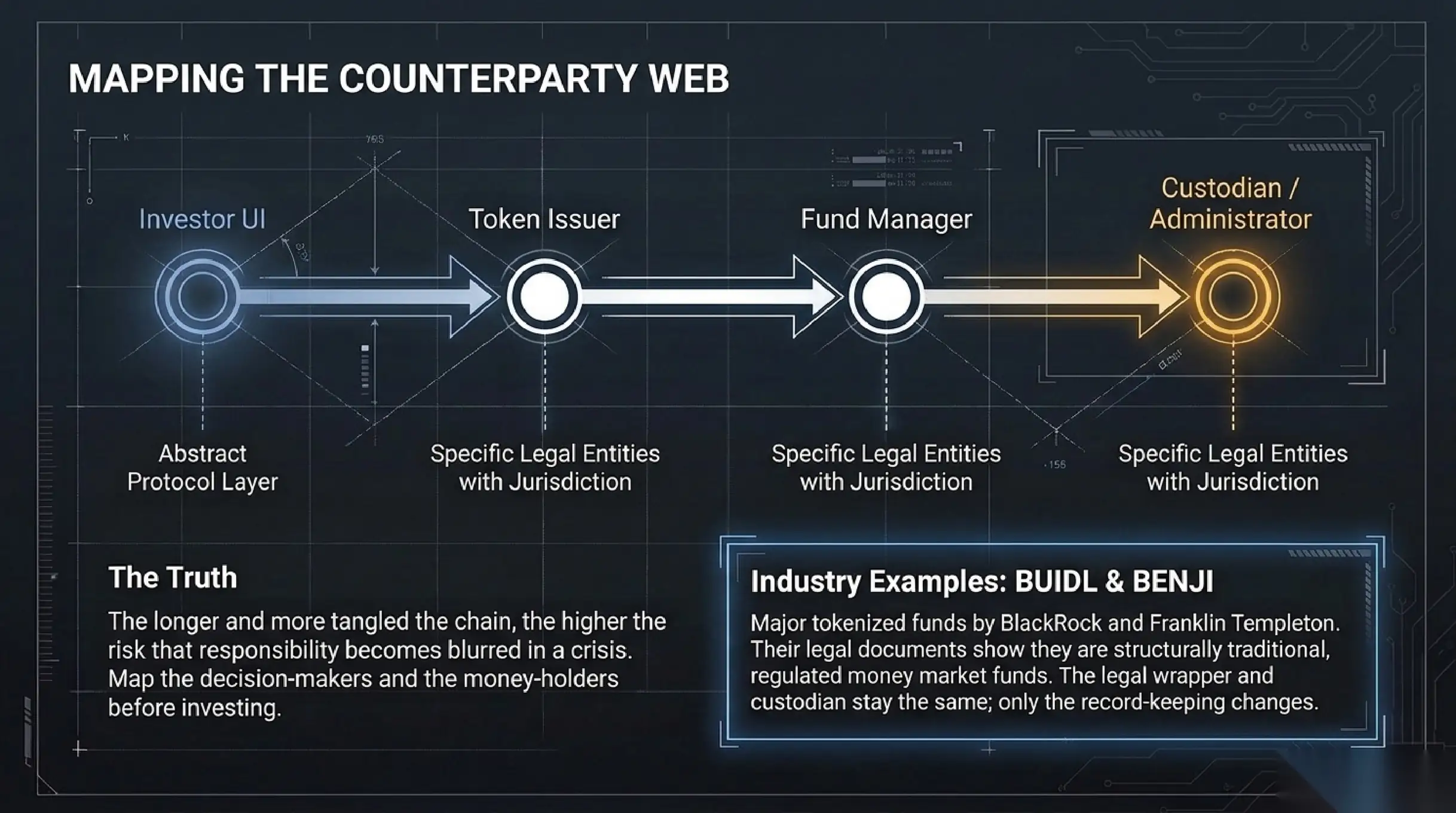
Behind a convenient interface there is always a specific legal entity, and it, not an abstract protocol, is the investor counterparty. It helps to find out who issues the token, who manages the fund, who holds the assets and how these roles are split among the group companies. Sometimes they are all one entity, sometimes a chain of several, and this determines whom the investor can make a claim against.
The longer and more tangled the chain, the higher the risk that responsibility becomes blurred in a crisis. A sensible investor builds a simple map: who holds the money, who makes the decisions and whose law will protect them in a dispute. If such a map cannot be drawn from public documents, that in itself is a signal of elevated risk.
A practical checklist
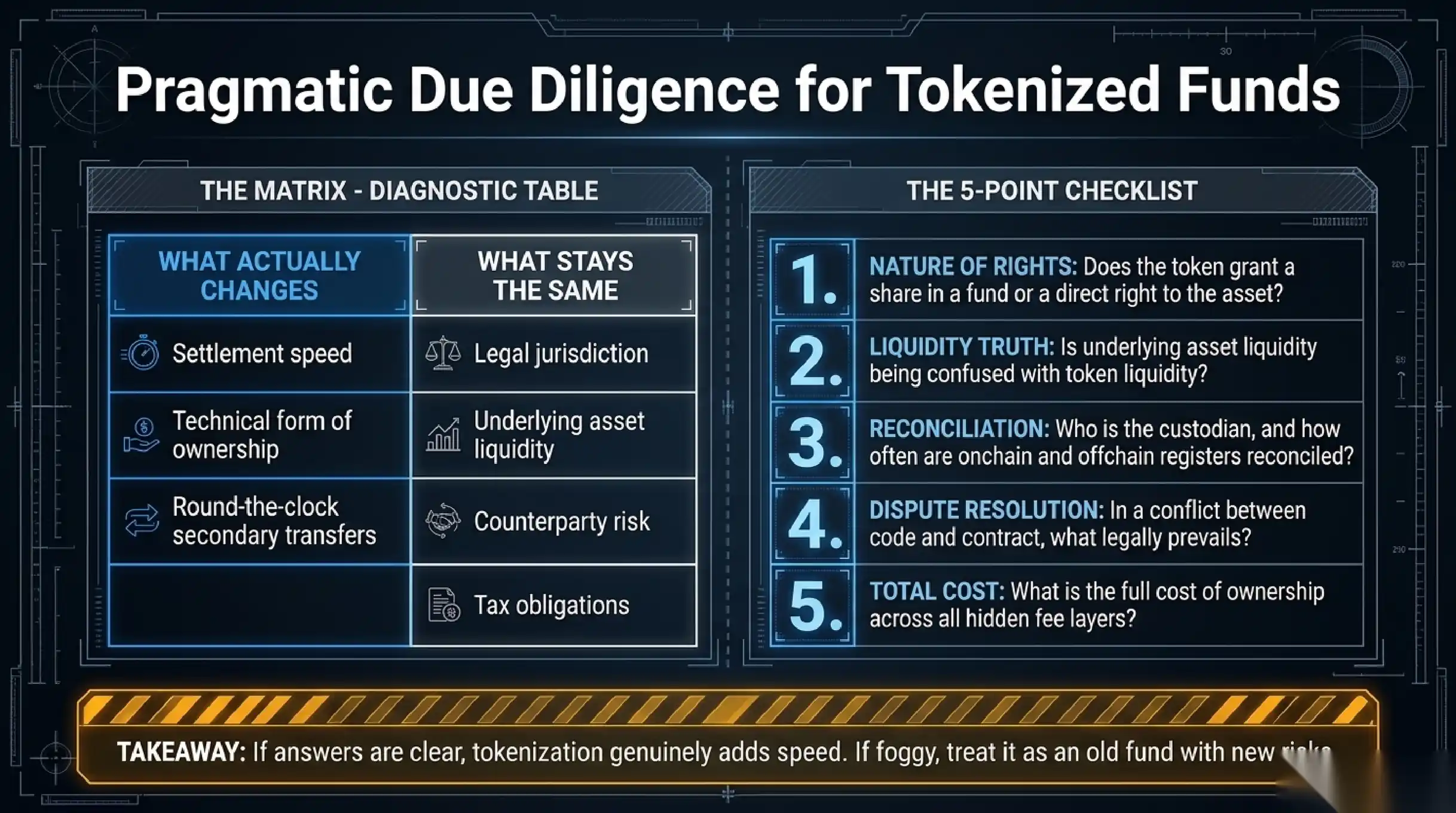
Before buying a share in a tokenized fund it helps to reduce the decision to a few checks. What the token actually grants: a share in the fund or a direct right to the asset. How liquid the underlying asset is and whether its liquidity is being confused with the token’s liquidity. Who the custodian is and how often the onchain and offchain registers are reconciled. What prevails in a conflict between code and contract. What the full cost of ownership is across all fee layers.
If each of these questions has a clear answer, tokenization genuinely adds convenience and speed. If even one stays foggy, it is wiser to treat the token as an old fund in a new wrapper and judge it strictly, rather than on the promise of instant settlement.
Examples and sources
Large examples of tokenized funds are BlackRock’s BUIDL and Franklin Templeton’s BENJI: both represent shares of a regulated money market fund as a token. Their documents show that the legal wrapper and the custodian stay the same, and what mainly changes is the way share ownership is recorded.
.png)